AT MACALESTER, I teach two courses every semester, one of which is lab-based. Mineralogy is offered each Fall term, and Petrology each Spring. The introductory level Volcanoes course is likely to become a permanent course offered every other year in the spring.


GEOL 250 Mineralogy — intro to minerals, symmetry, how atomic structure relates to physical properties, optical microscopy, mineral identification at multiple scales, intro to phase diagrams and petrogenesis, labs on hand samples, microscopy, symmetry; field trip
GEOL 302 Petrology — deep dive into phase diagrams, rock textures and relationships, geochemical diagrams, magmatic differentiation, metamorphic facies, labs and problem sets on all topics; field trip
GEOL 194 Volcanoes — accessible to any student across any major, intro to how volcanoes work, physical properties of magmas, case studies of volcanic eruptions around the world, oral histories of volcanic events, hazard and risk, crisis management, societal implications of volcanic crises, quantitative lab activities
AT PREVIOUS INSTITUTIONS, my first forays into teaching were as a TA for two summer field programs in geology, through the University of Georgia (Interdisciplinary Field Program and Field School). During my time in Hawaii, I also taught two sections of GG101 lab and developed in-class experiments for the GG300 Volcanology course. To build on these past experiences, I completed a teaching seminar course at Brown in Fall 2018 and became a coordinator for DEEPS STEP, an effort by our department at Brown to engage with K-12 teachers and students at local Providence schools. We designed and taught lesson plans that fed into the goal of fully implementing the Next Generation Science Standards adopted by Rhode Island.

A group of students from my 101L class, on a field trip to Big Island, HI (I’m in my typical field tie-dye). They had a great time exploring pāhoehoe flows, lava tubes, the glow from Kīlauea’s summit lava lake, and petroglyphs carved by early Hawaiians.
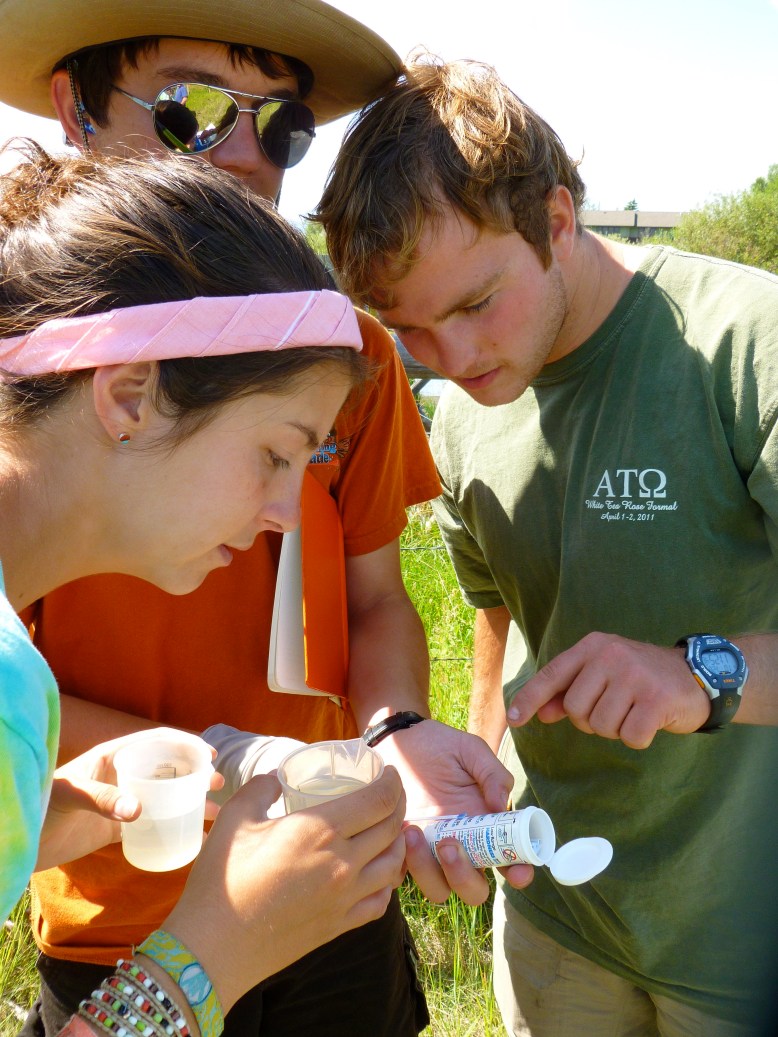
Students on University of Georgia’s Interdisciplinary Field Program (IFP) do several mini research projects, like this one measuring the stream health of Silver Bow Creek near the Superfund site in Butte, MT.

As part of the University of Georgia Field School, students fan out along Skyline Drive in Cañon City, CO. They are looking for fossils, dinosaur footprints, and other clues that point to the age and sequence of the layers.

Lava Beds National Monument is full of incredible drained lava tubes from the eruptions of Medicine Lake, a dormant shield volcano in northern California. Here, a group of students, a fellow TA, and myself explore one of the caves during IFP 2011.

When your field programs travel across the country, home is where the tent is. Students analyze soil samples, write papers, help the cooks, and study together, by headlamp if necessary!
 Emily First